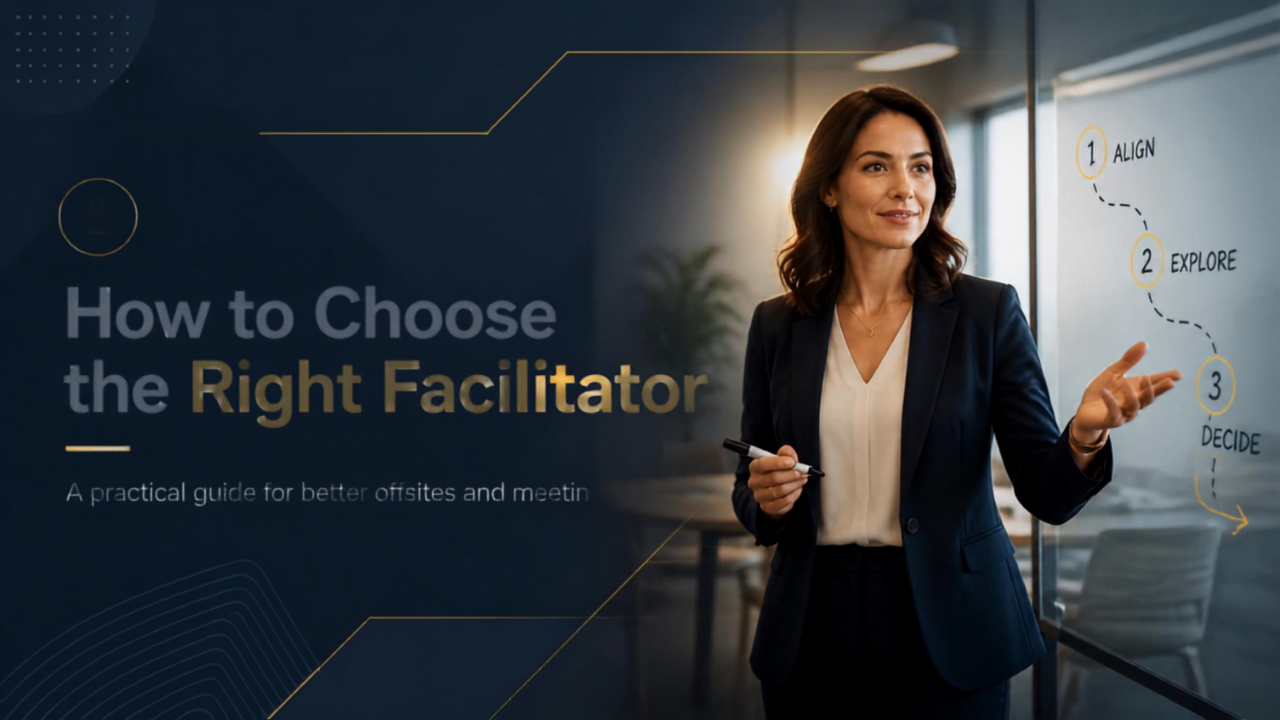
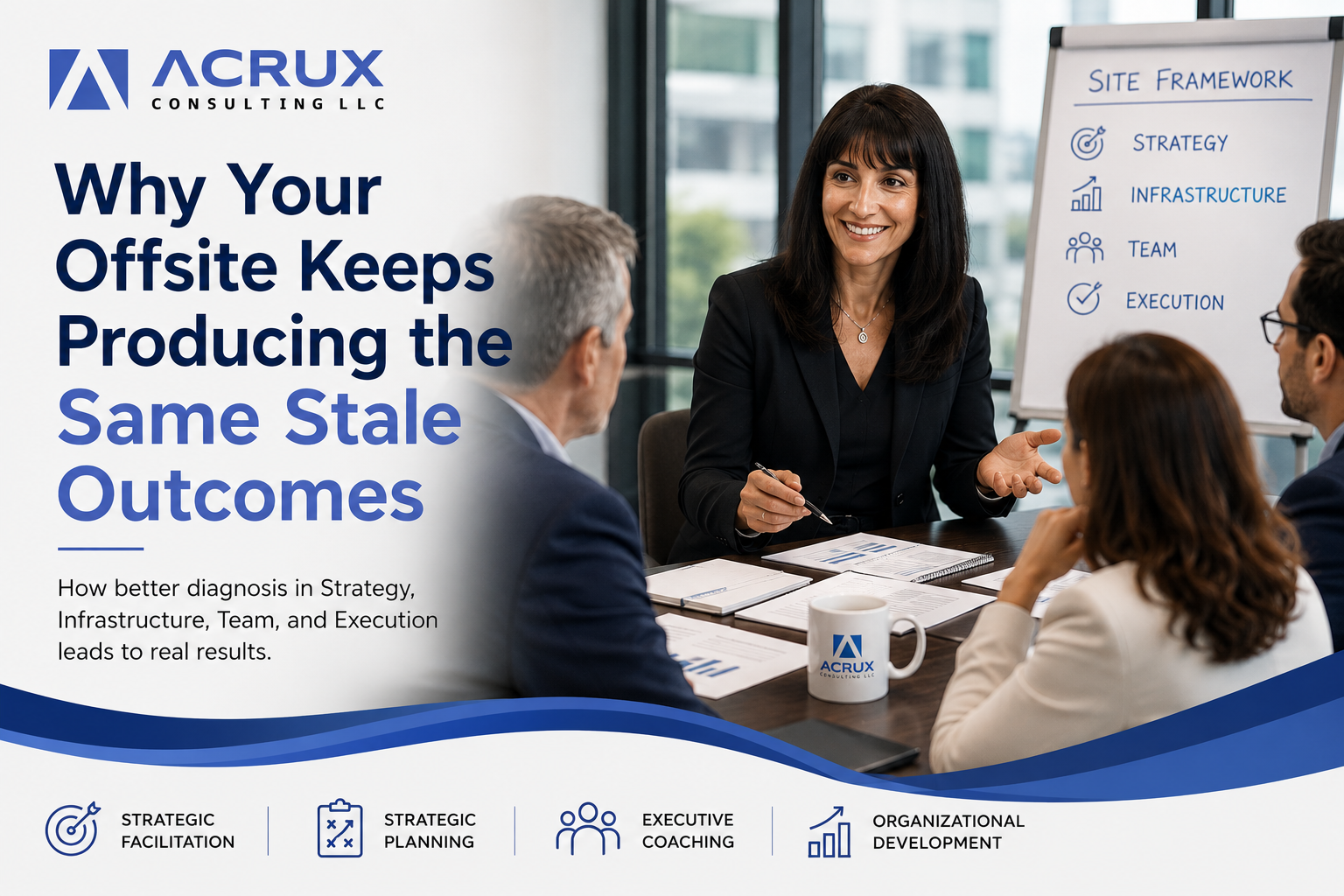
Problem-Solving Under Pressure: Leadership Training for Quick, Collaborative Decisions in 2026
In today’s leadership environment, the real test of effectiveness isn’t what happens when there is time to think. It’s what happens when there isn’t.
A major client escalation. A market shift that changes assumptions overnight. A strategic initiative that begins to stall under competing priorities. These are the moments when leadership teams must solve problems quickly and together.
Yet most leadership teams are not trained to make collaborative decisions under pressure. They rely on informal habits, dominant personalities, or fragmented conversations that create motion without clarity.
The result isn’t just slower decisions. It’s weaker decisions. And more importantly, decisions that lack the alignment necessary for execution.
This is why leadership training focused on executive coaching for facilitation and collaborative decision-making has become essential in 2026.
The Real Challenge Isn’t Speed. It’s Alignment Under Pressure.
When pressure rises, leadership teams often fall into predictable patterns.
Decisions are escalated that could have been resolved closer to the work. A few voices begin to dominate while others disengage. Conversations focus on immediate symptoms rather than underlying causes. Teams leave meetings believing they are aligned, only to discover later that they each interpreted the decisions differently.
From the outside, this can appear decisive. From the inside, it often creates the very misalignment that slows execution and undermines momentum.
This is where executive coaching and consulting focused on facilitation capability can have a significant impact. Effective leaders do more than make decisions. They create the conditions for productive dialogue, guide teams through complexity, and help groups reach clear, shared conclusions that people understand and support.
The ability to facilitate alignment is not separate from leadership. It is one of the ways leadership becomes effective at scale.
Why Facilitation Is the Critical Leadership Skill of 2026
Leadership today is less about having the right answers and more about enabling the right decisions to emerge from the team.
The most effective leaders create environments where:
- The right voices are heard
- Assumptions are surfaced and tested
- Tradeoffs are examined openly
- Decisions are clearly defined and owned
This is the essence of executive coaching and facilitation. It shifts the leader’s role from decision-maker alone to decision architect.
Organizations that invest in leadership training focused on facilitating a strategy session or collaborative problem-solving consistently make faster, higher-quality decisions and execute them more effectively.
A Client Example: When Pressure Threatened Progress
A senior leadership team at a healthcare organization was facing mounting pressure to define priorities for a new strategic initiative. Deadlines were approaching, and discussions had become circular. Each meeting produced new ideas, but no clear decisions.
The CEO was highly capable and respected, but their instinct was to resolve uncertainty by offering conclusions early in the discussion. This unintentionally shut down debate and prevented the team from fully examining the tradeoffs.
Through executive coaching for facilitation, the CEO adopted a different approach.
Instead of offering answers, they structured the conversation around key questions:
- What assumptions are we making?
- What risks do we face if we delay?
- What decision must be made now versus later?
The result was immediate. The team aligned around priorities in a single session decisions that had eluded them for months.
The difference wasn’t intelligence or urgency. It was facilitation.
The Capabilities Leaders Must Develop
Leadership training focused on collaborative problem-solving builds several critical capabilities.
1. Structuring Conversations for Clarity
When pressure rises, conversations often become reactive. Leaders trained in strategic planning facilitation know how to create structure quickly clarifying objectives, framing questions, and guiding discussion toward decisions.
Structure accelerates clarity.
2. Separating Exploration from Decision
Many leadership teams blur exploration and decision-making. Effective leaders create clear transitions between the two.
They allow space for ideas to surface but recognize when it is time to converge and decide.
This ensures decisions are both informed and timely.
3. Managing Group Dynamics Under Pressure
Pressure amplifies leadership dynamics. Some individuals become more vocal, others more cautious.
Leaders trained in executive coaching and facilitation recognize these patterns and create balance ensuring the best ideas surface regardless of hierarchy.
4. Driving Shared Ownership of Decisions
Execution depends on ownership. When leaders facilitate decisions collaboratively, participants leave with clarity and commitment.
This dramatically improves follow-through.
Why Traditional Leadership Training Falls Short
Most leadership training focuses on communication, delegation, or individual effectiveness.
These skills matter but they do not address the core challenge leadership teams face today: making complex decisions together under pressure.
Leadership training must now include facilitation capability the ability to guide groups toward clarity and alignment in real time.
This is why organizations increasingly invest in executive coaching for facilitation and strategic planning facilitation as core leadership development tools.
The Competitive Advantage of Collaborative Decision-Making
Organizations that develop facilitation capability within their leadership teams gain a critical advantage.
They:
- Respond faster to change
- Make better strategic decisions
- Avoid prolonged misalignment
- Execute with greater consistency
In an environment defined by uncertainty, the ability to facilitate collaborative decisions is no longer optional. It is a defining leadership skill.
How Leadership Teams Can Begin
Improving collaborative problem-solving capability begins with leadership awareness.
Leaders must recognize that their role is not only to contribute expertise—but to guide the decision-making process itself.
Through executive coaching and consulting, leaders learn how to:
- Structure strategic discussions
- Facilitate effective strategy sessions
- Guide teams toward clear, aligned decisions
- Build sustainable internal facilitation capability
These skills strengthen leadership teams long after individual decisions are made.
Conclusion: Leadership Is Defined by the Decisions You Enable
The most effective leaders are not the ones who make every decision themselves. They are the ones who create the conditions for their teams to make clear, confident decisions together even in moments of uncertainty and pressure.
Organizations that invest in executive coaching for facilitation and strategic planning facilitation strengthen their collective leadership capacity. They develop teams that can align quickly, navigate complexity, and move forward with greater clarity and confidence.
As organizations face increasingly complex challenges, facilitation is becoming more than a meeting skill. It is a leadership discipline—one that enables better thinking, stronger alignment, and more effective execution.
FAQ SECTION
Why is facilitation important for leadership teams?
Facilitation ensures leadership teams make clear, aligned decisions by structuring conversations, balancing participation, and guiding groups toward shared conclusions.
How does executive coaching improve decision-making?
Executive coaching strengthens leaders’ ability to guide discussions, surface assumptions, and help teams reach decisions more efficiently and collaboratively.
What is strategic planning facilitation?
Strategic planning facilitation helps leadership teams define direction, align priorities, and establish clear action plans through structured, collaborative sessions.
Can facilitation skills be learned?
Yes. Leaders can develop facilitation skills through executive coaching and leadership training focused on collaborative decision-making.