Why Strategic Plans Fail: 5 Pitfalls Even Smart Teams Miss
By Diana Gurwicz, Acrux Consulting
Strategic planning should be the moment when everything clicks—vision becomes direction, direction becomes execution. Yet too often, it’s the start of a slow unravelling. The team leaves the room nodding, the slide deck looks polished, and the metrics are promising. But a few months later, momentum fades, priorities shift, and no one’s quite sure why it didn’t work.
After decades facilitating strategic planning for organisations of every size—from private equity-backed firms to public sector agencies—I’ve seen the patterns. The problem isn’t that leaders aren’t smart. It’s that some common pitfalls hide in plain sight.
Here are five of the most critical strategic planning mistakes—and what you can do to avoid them.
1. The Illusion of Alignment
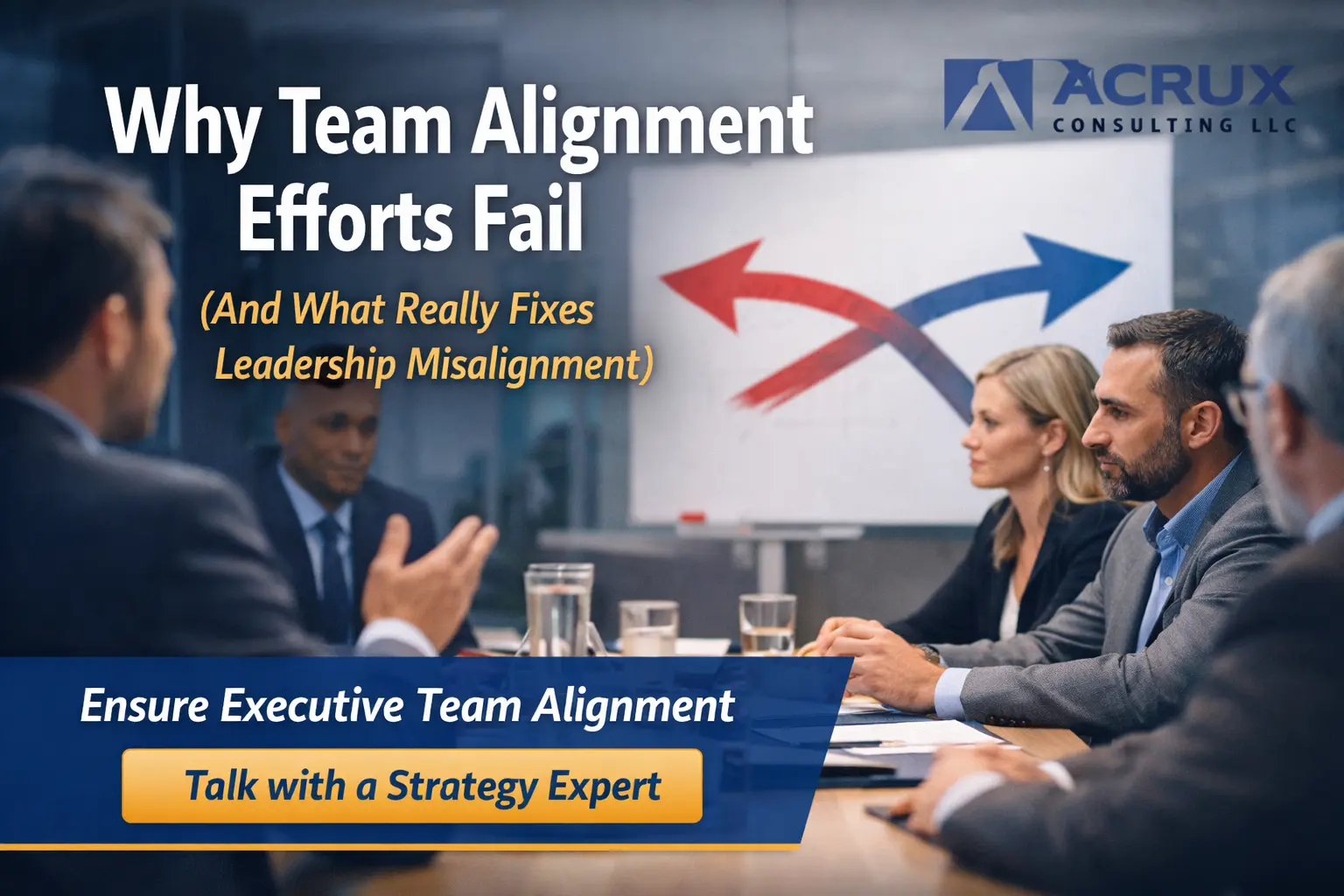
One of the most dangerous outcomes of any strategic planning session is false consensus. People nod, agree in the moment, and walk out with entirely different interpretations. I call this the Execution Mirage—when everyone believes they’re aligned, but subtle disconnects start to compound.
In your planning process, ask:
Are we actually clear on what success looks like?
Have we defined who owns what, and how decisions will be made?
Have we surfaced the uncomfortable tradeoffs—or avoided them?
True alignment isn’t about agreement in the room. It’s about clarity that sustains outside of it.
2. Strategy as a Slide Deck, Not a Commitment
A strategic plan isn’t a presentation—it’s a contract for behavior. Too often, it becomes a document that’s presented, then shelved. Without a mechanism to translate vision into habits, your plan is just storytelling.
Facilitated planning helps teams make the shift from talking about goals to committing to them. That includes identifying barriers, setting realistic timelines, and holding one another accountable—long after the offsite ends.
3. Measuring the Wrong Things
Teams often track what’s easy to measure—not what’s meaningful. Vanity metrics or overly broad KPIs give a false sense of progress while masking deeper performance issues.
At Acrux, we help organizations distinguish between performance indicators and strategic indicators.
Performance tells you how you’re doing.
Strategy tells you whether you’re doing the right things at all.
If you’re only looking at lagging indicators, you’re steering from the rearview mirror.
4. Avoiding the Hard Conversations
Most strategic plans fall apart because leaders are reluctant to name what’s really going on.
Turf wars.
Competing agendas.
Dysfunction that everyone feels but no one wants to say out loud.
In our work with Reser’s Fine Foods, we helped an executive team break through surface-level agreement to uncover what was truly holding them back. That single moment of clarity reset the strategy and unlocked a level of commitment they hadn’t seen before.
Good facilitation isn’t about managing a meeting—it’s about creating the space for honest, uncomfortable, and essential conversations.
5. No Real Mechanism for Follow-Through
Finally, many strategic plans fail because there’s no engine to drive them forward. Goals are vague, ownership is unclear, and no one is checking in on progress in a meaningful way.
A great plan includes:
Clear, time-bound priorities
Defined roles and decision rights
A regular cadence for review and adaptation
Without this, even the most brilliant strategy will stall in execution.
Bringing Strategy to Life
At Acrux Consulting, we don’t just facilitate planning—we help leadership teams recalibrate, align, and execute with confidence. If your organization is facing complex shifts, rapid growth, or internal friction, a better strategy session can change your trajectory.
Ready to avoid these pitfalls? Let’s talk.
[Schedule a call Acrux Consulting LLC