The Hidden Leadership Crisis HR Leaders Can't Afford to Ignore in 2026
Organizations across every industry are making the same bet right now: flatten the structure, cut middle management, let AI handle the rest. It sounds efficient. It looks good on a quarterly report. But HR and organizational development leaders are starting to see what’s coming next and it’s not pretty.
The leadership pipeline is being quietly hollowed out, one restructuring at a time.
If you’re an HR leader or OD professional trying to figure out where the next generation of executives will come from, this post is for you.
Why the Pipeline Is Drying Up
According to Gartner’s 2026 CHRO Priorities report, AI transformation tops the agenda for HR leaders this year — but right behind it is a challenge that may prove harder to solve: mobilizing leaders for growth during uncertainty.
The timing couldn’t be more awkward. At the same moment organizations need adaptive, decisive leadership more than ever, they’re systematically eliminating the roles that develop it.
Korn Ferry’s recent research found that 82% of boards and chief executives plan to reduce up to 20% of their workforces in the next three years due to AI with middle managers and entry-level roles taking the biggest hit. These are not fringe cuts. They’re surgical removals of the very layers where leadership competency has traditionally been built: the difficult conversations, the cross-functional negotiation, the hard-won decision-making under pressure.
You can’t automate your way to your next VP of Operations. And you can’t develop leaders in roles that no longer exist.
The Real Cost of “Culture Atrophy”
Gartner researchers have identified something they call “culture atrophy” a state where the pace of organizational change has outrun the organization’s ability to adapt, leaving employees disengaged and leadership disconnected from reality on the ground.
This isn’t just an employee experience problem. It’s a strategic execution problem.
When leadership teams are misaligned when the people in the room aren’t talking to each other honestly, or when strategy sessions produce agreement but zero accountability the organization stalls. Not dramatically. Quietly. Initiative by initiative. Quarter by quarter.
HR and OD leaders are uniquely positioned to see this pattern forming. The question is whether the organization’s leadership will act before the stall becomes a crisis.
What the Research Is Telling Us About What Actually Works
Deloitte’s 2026 Global Human Capital Trends report surveyed more than 9,000 business and HR leaders and found that the two most critical success factors right now are:
- Accelerating how people and resources are orchestrated to perform work
- Increasing the organization’s ability to adapt to change and speed
Notice what both of those require: human alignment. Not better software. Not a new org chart.
People who can make decisions together, communicate across divisions, and execute on commitments they’ve actually made — not ones they nodded at.
This is where facilitated leadership development and structured team alignment become strategic, not administrative.
The OD Intervention That’s Often Overlooked
Many OD teams default to training programs when they identify a leadership gap. And training has its place. But training alone rarely shifts organizational culture or team dynamics. It doesn’t surface the unspoken tensions that derail execution. It doesn’t build the collective decision-making muscle a leadership team needs when the pressure is real.
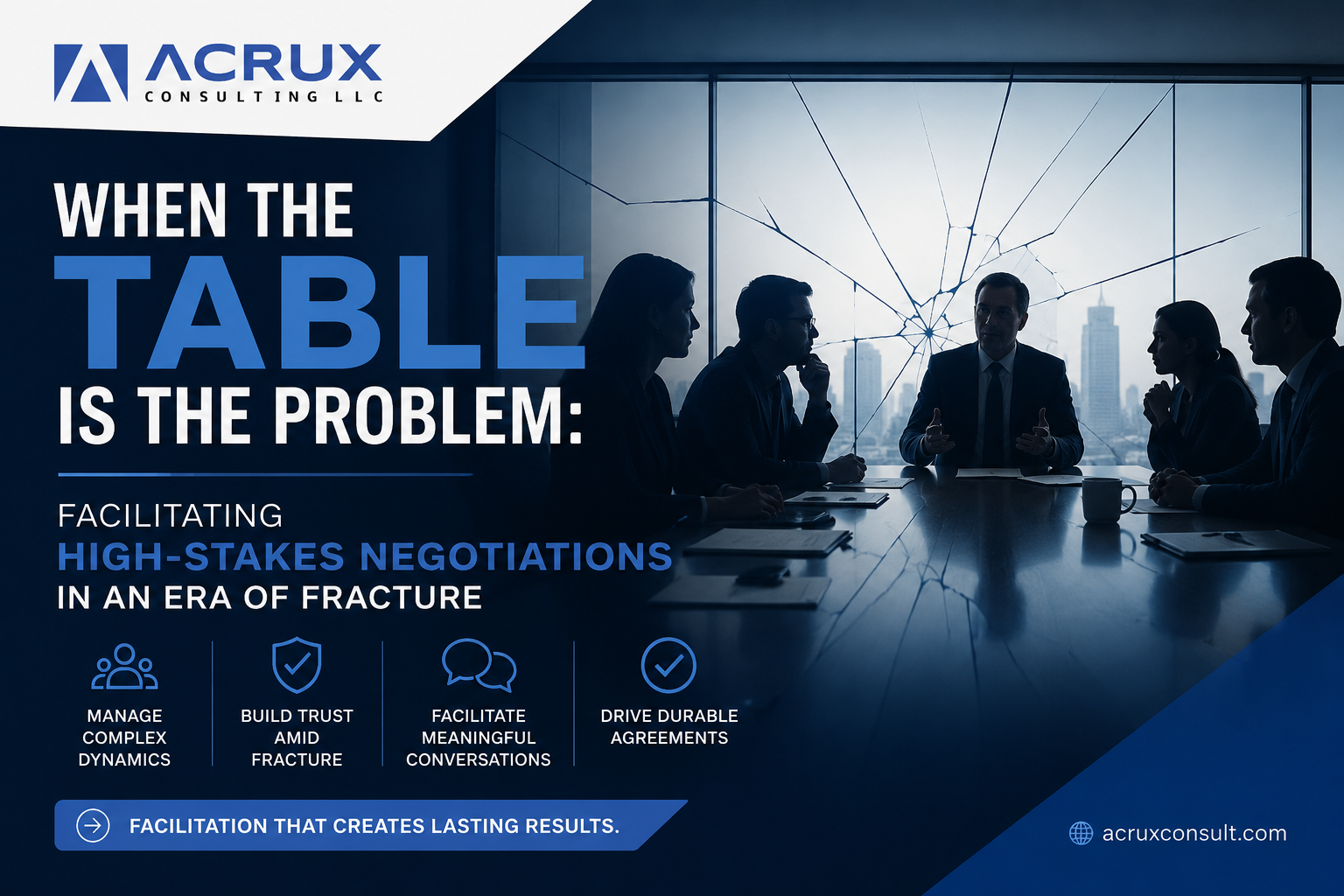
What does move the needle? Structured, expert-facilitated sessions that bring leadership teams into honest dialogue about their actual challenges and leave with real commitments, clear ownership, and a plan that doesn’t evaporate the moment someone walks out of the conference room.
Facilitated strategic alignment sessions work because they do what most internal meetings can’t: create conditions where every voice gets heard, hard truths surface safely, and decisions actually hold.
For HR and OD leaders, this is often the missing link between a well-designed talent strategy and the organizational behavior change they’re trying to drive.
Five Signs Your Organization Needs Facilitated Leadership Alignment Now
You don’t always get clear signals before a leadership crisis. But there are patterns that experienced OD professionals recognize:
- Strategy sessions produce agreement, but little follow-through. The room nods. The deck looks great. Six weeks later, nothing has changed and no one is sure who owns what.
- Senior leaders are talking around issues rather than through them. Meetings are polite. Real concerns surface in hallway conversations after or not at all.
- A significant change is underway merger, restructuring, new market entry and the leadership team hasn’t been aligned on how to lead through it together.
- High-potential managers are leaving. If your emerging leaders aren’t seeing a path forward or feel like they’re caught between competing executive agendas they’ll find clarity somewhere else.
- HR keeps recommending the same interventions and seeing the same problems. When training and coaching aren’t moving the needle, the issue is usually systemic: it lives in the team dynamic, not in any individual.
What HR Leaders Should Be Prioritizing This Quarter
If you’re an HR or OD leader reading the 2026 research, here’s the practical translation:
Build or protect leadership development pathways before the pipeline gap becomes visible to the CEO. By then, it’s a crisis, not a planning problem.
Make the case for facilitated alignment as a core organizational development tool not a retreat luxury. Boards and executive teams that can make faster, cleaner decisions are a competitive advantage.
Connect leadership development to business outcomes, not just competency frameworks. The organizations winning right now are the ones where people and strategy move at the same speed.
The Bottom Line
The organizations that will navigate 2026 successfully aren’t the ones that cut most aggressively.
They’re the ones that invested in their leaders’ ability to align, adapt, and execute together especially when the environment was uncertain.
HR and OD leaders have a rare window right now to make that case internally and to build the infrastructure that makes it possible.
If your leadership team is talented but struggling to translate that talent into traction, the gap is usually alignment not ability.
Acrux Consulting helps leadership teams surface the real issues, work through them directly, and make decisions that hold after the meeting ends. Our facilitation is custom-designed for each organization no templates, no generic agendas.