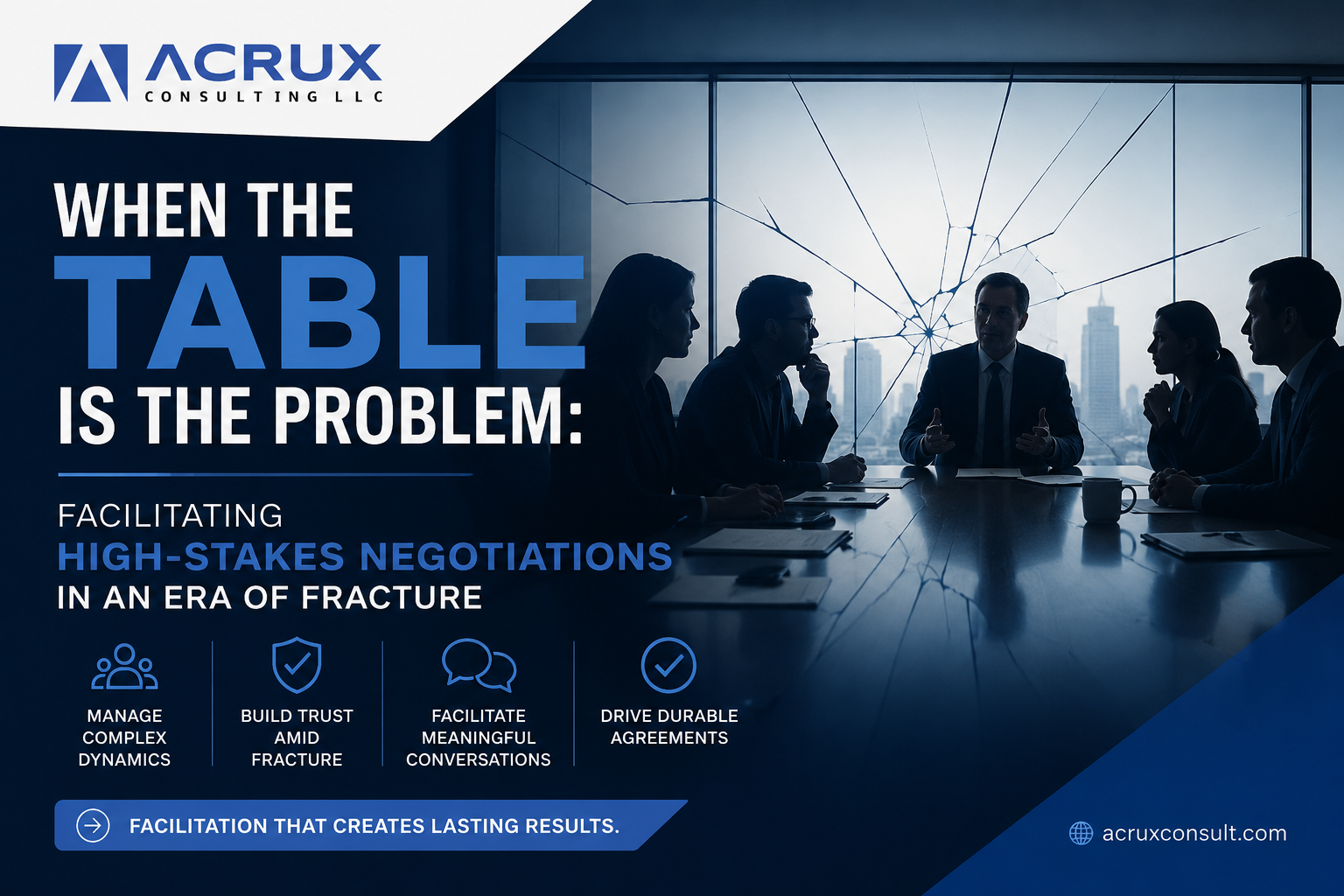
Uncovering Hidden Misalignment in U.S. Executive Strategy Sessions
There is a moment in almost every executive strategy session that fascinates me.
The slide changes. Heads nod. Someone says the direction feels right. The room relaxes slightly. The energy shifts from tension to forward motion.
It looks like alignment.
And sometimes it is.
But often, what I’m watching is something quieter a decision moving forward without having truly been metabolized by the people responsible for carrying it.
After years of facilitating executive conversations, I have learned that some of the most significant organizational risks are not visible in moments of disagreement. They are visible in moments of apparent agreement that have not been thoroughly tested.
That distinction matters more than many leadership teams realize.
The Illusion of Alignment in Executive Meetings
In U.S. executive teams especially, misalignment rarely shows up as open resistance. It doesn’t erupt into conflict. It rarely sounds dramatic. Instead, it hides behind professionalism.
Leaders are thoughtful. Measured. Careful with political capital. No one wants to be the outlier. No one wants to slow the room down unnecessarily. And in high-performing environments, disagreement can feel like friction rather than contribution.
Many executives have spent years building credibility and influence. They understand the dynamics of leadership teams and often choose their moments carefully. As a result, questions, concerns, or alternative interpretations may remain unspoken even when they are highly relevant to the discussion.
So the room moves on, because the leaders feel that is what senior leadership expects in order to show they are “on board.” To not do that might be seen as resistance. As someone once said at McKinsey, it could be a “career-limiting move.”
And so everyone signals agreement.
The challenge is that visible agreement and genuine alignment are not the same thing.
One can be observed in a meeting.
The other can only be proven through execution.
A Real Example of Hidden Misalignment in Action
I worked recently with a leadership team at a mid-sized company that had just declared a bold strategic pivot. The CEO articulated it clearly. The rationale made sense. The room nodded. The language of commitment was used. By the end of the session, everyone agreed they were aligned.
Three weeks later, progress was uneven.
Manufacturing had barely adjusted capacity assumptions. Sales was still incentivized around legacy products. HR had not shifted hiring priorities. Finance was modeling conservatively, as if this were still an experiment rather than a directional shift.
When we unpacked it, no one had intentionally resisted.
They had simply left the room with different interpretations.
Some believed the pivot was a signal to explore new markets cautiously. Others believed it was an immediate reallocation of capital and focus. A few assumed implementation would be staged next year. The CEO assumed urgency had been understood.
Everyone believed they were aligned.
They weren’t.
What became clear was that each executive had heard the same words but attached different meanings, timelines, and expectations to them. The strategy itself was not unclear. The interpretation of the strategy varied significantly across the leadership team.
That gap became visible only after execution began.
How Polite Agreement Masks Strategic Risk
What had been missing wasn’t intelligence or commitment.
It was shared interpretation.
Hidden misalignment doesn’t live in whether people like the strategy. It lives in how they define it.
Two executives can leave the same conversation carrying completely different mental models about what just happened.
One assumes resources will be reallocated. Another assumes teams will absorb the work.
One believes risk tolerance has shifted. Another assumes guardrails remain unchanged.
One sees transformation. Another sees a pilot.
None of them are being disingenuous.
They are operating from assumptions that were never made visible.
And because the meeting felt productive, the organization assumes alignment has been achieved.
This is where executive teams often underestimate the importance of facilitated dialogue. Without deliberate efforts to surface assumptions, leaders can unknowingly create multiple versions of the same strategy inside the organization.
The cost of that divergence is rarely immediate.
But it is almost always expensive.
Why Execution Breakdowns Often Begin in the Strategy Room
The fracture shows up later.
It shows up when timelines stretch.
When enthusiasm cools.
When execution feels uneven across functions.
When someone quietly says, “That’s not what I thought we were doing.”
By then, the strategy gets questioned. Or the team’s discipline gets questioned.
But often the strategy wasn’t the problem.
The surface alignment was.
Many execution challenges that organizations attribute to accountability, communication, or performance are actually rooted in unresolved ambiguity that existed from the beginning.
The strategy room is where alignment is either strengthened or weakened.
What happens there determines how effectively the organization moves afterward.
What True Executive Alignment Actually Requires
There is something particularly American about this dynamic. Many U.S. executive cultures value momentum. Efficiency. Decisiveness. Meetings that end on a clear forward note.
What we don’t always value is the slower work of pressing into ambiguity long enough to expose differences in interpretation.
The deeper questions are harder:
Are we aligned on the level of risk this requires?
Are we aligned on what we are willing to stop?
Are we aligned on how this changes decision rights or incentives?
Are we aligned on the urgency?
Are we aligned on what success actually looks like six months from now?
Those conversations can feel destabilizing in a room full of peers.
So instead, teams close the deck and move forward.
The irony is that surfacing misalignment early is far less destabilizing than discovering it mid-execution.
Real alignment is not the absence of tension.
It is the resolution of tension through clarity.
The strongest executive teams are not those that avoid disagreement. They are the teams that create enough trust and structure to examine disagreement before decisions leave the room.
If your executive team keeps experiencing execution breakdowns after strong strategy sessions, it may not be a performance issue.
It may be that misalignment was polite enough to go unnoticed.
And polite misalignment is one of the most expensive dynamics in American executive culture.