What to Look for in the Best Professional Facilitation Service for Executive Offsites
Every executive team eventually hits the same wall: the offsite that produces energy but not decisions. The team leaves the room aligned on tone, vague on substance, and back to the same operating patterns within two weeks. That’s rarely a people problem. It’s a design problem and it’s exactly what a strong facilitation partner is built to solve.
If you’re evaluating the best professional facilitation service for your next executive offsite, here’s what actually separates a well-run session from an expensive team lunch.
1. A Diagnostic Process, Not a Template
The best facilitation services don’t start with an agenda template. They start with a diagnostic understanding where the organization is actually stuck before deciding what the room needs to do together.
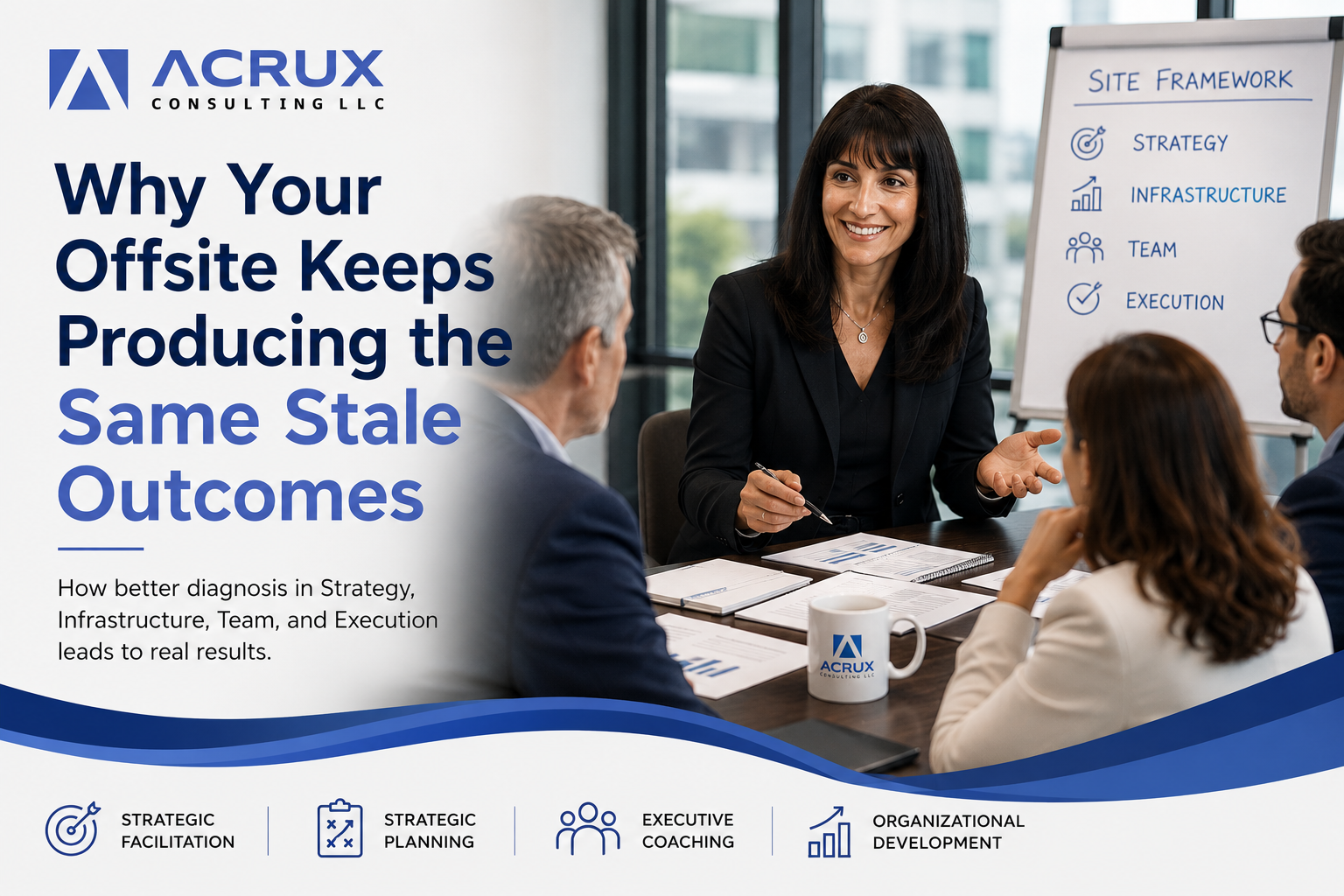
At Acrux, that diagnostic runs through the SITE Assessment framework: Strategy, Infrastructure, Team, and Execution. Before we build a single slide, we’re looking for where the friction really lives. Is this a strategy clarity problem? An infrastructure bottleneck masquerading as a people issue? A team dynamics issue that’s been quietly eroding decision quality for months? The offsite design follows the diagnosis not the other way around.
2. Facilitation Built Around Real Decision Rights
A strong executive offsite isn’t a series of open discussions. It’s a structured sequence of decisions, and the best facilitators design explicitly around who owns what. That means being clear often using frameworks like RASCI or ABCD about who is deciding, who is consulted, and who is simply informed, before the room ever convenes.
For a recent multi-day offsite involving a CEO, CRO, COO, CFO, and two entity presidents, this distinction mattered enormously. Cross-functional executive teams almost always contain more shared authority and more competing priorities than a single agenda item can hold. Facilitation that doesn’t account for that ends up either forcing false consensus or letting the loudest voice win by default.
3. Sessions That Are Built Around a Small Number of Sharp Strategic Questions
The best offsites aren’t organized around topics. They’re organized around a handful of high-stakes questions the leadership team genuinely doesn’t have settled answers to yet things like how the organization defines its own identity under growth pressure, where the real trade-off sits between focus and complexity, or how much risk the business is actually willing to carry in its next chapter.
Three to five sharp questions, sequenced deliberately over a day and a half, will produce more clarity than a twenty-item agenda ever will.
4. Facilitator Independence
An external facilitator brings something no internal leader can: no stake in the outcome. That independence lets a facilitator name the tension in the room that everyone else is managing around the unspoken disagreement, the leader who’s checked out, the decision that keeps getting revisited because it was never really made. This is one of the clearest arguments for bringing in outside facilitation for high-stakes executive sessions rather than running it internally, and it’s worth its own conversation (see the FAQ below).
5. Credentials That Reflect Actual Rigor
“Facilitator” is not a protected title, and the market is full of people who run meetings well but haven’t been evaluated against a rigorous, external standard. When you’re vetting a facilitation partner for an executive offsite, ask directly about certification. A Certified Master Facilitator (CMF) credential held by a very small number of practitioners worldwide reflects a level of assessed mastery well beyond someone who has simply facilitated a lot of meetings. It’s worth asking any prospective facilitator what their credentials actually certify, and who certified them.
6. Documentation That Outlives the Room
The offsite isn’t the deliverable. What the organization does with it afterward is. The best facilitation services leave behind more than a slide deck full session notes, a clear record of what was decided versus what was merely discussed, and a documented path for follow-through. Without that, even a well-run offsite quietly reverts to business as usual within a month.
Frequently Asked Questions
How is facilitation for cross-functional teams different from executive offsite facilitation?*
Cross-functional facilitation typically focuses on breaking down silos between departments that share a project or process. Executive offsite facilitation operates at a different altitude it’s about aligning the people with ultimate decision authority over the organization’s direction, which raises the stakes around decision rights, confidentiality, and unspoken power dynamics.
Do we need an external facilitator, or can someone internal run this?
Internal facilitation works fine for routine meetings. For high-stakes executive alignment succession, governance, compensation, restructuring an external facilitator’s independence is usually the deciding factor. Internal facilitators, however skilled, carry organizational history and reporting relationships into the room that can’t be fully set aside.
What makes a facilitation service “best” for high-stakes meetings specifically?
High-stakes meetings need facilitators who can hold tension in the room without rushing to false resolution, who design for decisions rather than discussion, and who can document outcomes with enough precision that “what we decided” isn’t up for reinterpretation a week later.
How do we know if we need strategic planning facilitation versus stakeholder alignment facilitation?
If the core problem is “we don’t agree on where we’re going,” that’s strategic planning facilitation. If the strategy is largely settled but execution is stalling because stakeholders aren’t rowing together, that’s an alignment problem and it calls for a different session design entirely.
Author Bio:
Diana Gurwicz is the Founder and President of Acrux Consulting, a Certified Master Facilitator (CMF), Certified Executive Coach, and Wharton MBA specializing in executive offsite facilitation, strategic planning, and organizational infrastructure.