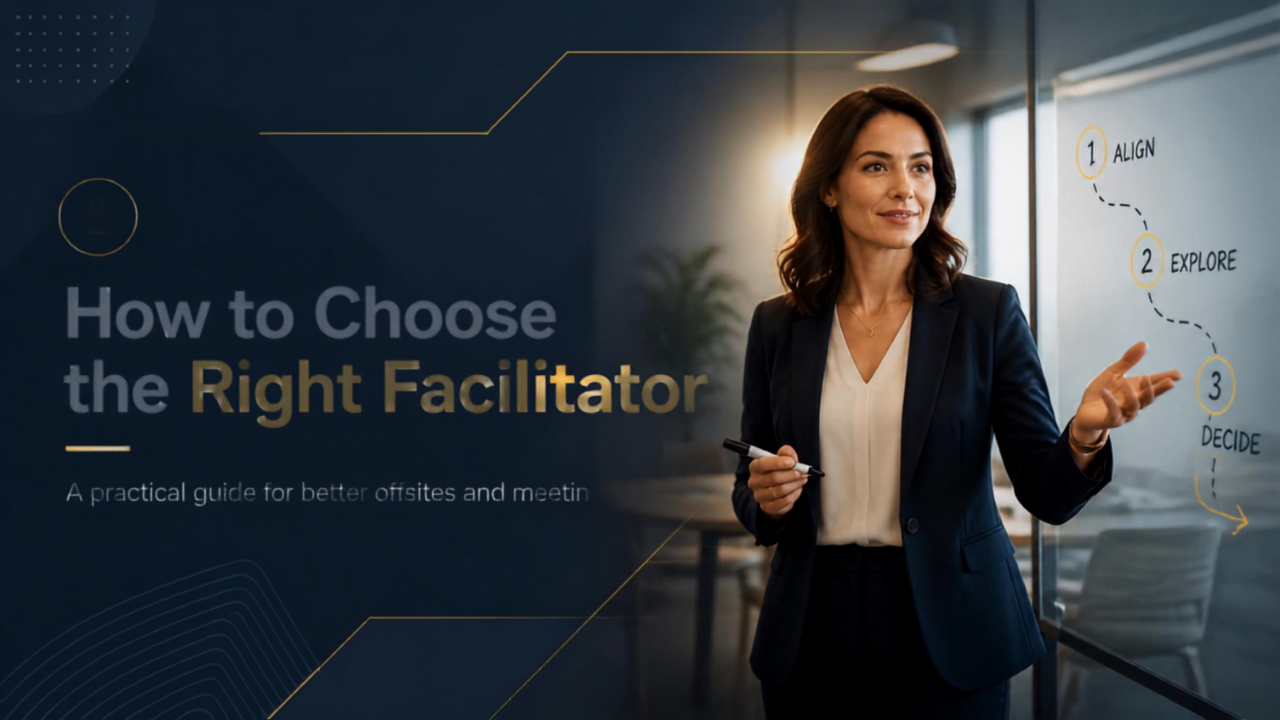
How to Choose the Right Facilitator for Your Executive Team
(And Why It Matters More Than You Think)
You’ve got a room full of smart, experienced leaders. The agenda is set. The stakes are real. And yet three hours later, you leave with the same unresolved tensions, a vague action list nobody owns, and a quiet, collective sense that the meeting didn’t move anything forward.
Sound familiar?
This isn’t a talent problem. It’s a facilitation problem. And it’s exactly why more executive teams, boards, and public-sector organizations are bringing in a professional facilitator before their next high-stakes session.
But not all facilitators are the same. Here’s what to look for and how to find the right one for your team.
What Does a Professional Facilitator Actually Do?
A facilitator’s job isn’t to run a meeting. It’s to design a process that produces a specific outcome alignment, a decision, a strategy, a resolution and then guide the group through it with enough structure to create clarity and enough flexibility to surface what’s real.
Good facilitation does three things most meetings don’t:
1. Creates equal voice. In any room with a hierarchy, people self-censor. A skilled facilitator builds in structures (anonymous input, small-group breakouts, deliberate turn-taking) that give quieter voices the same weight as the loudest person in the room.
2. Surfaces the real issue. Most groups talk around the problem. A facilitator’s job is to help the group name what’s actually in the room the tension nobody’s raised, the assumption everyone’s making, the disagreement that keeps resurfacing in different forms.
3. Produces decisions that hold. The measure of a great facilitation isn’t how the session felt it’s whether the commitments made in the room survive contact with reality. A professional facilitator builds in accountability, ownership, and follow-through before anyone leaves.
5 Signs You Need a Professional Facilitator
Not every meeting needs a facilitator. But these situations almost always do:
1. Your strategy sessions produce agreement but not action
If your leadership team leaves retreats aligned in the room but fragmented a week later, the problem isn’t commitment it’s that the process didn’t build real alignment. A facilitator helps surface the undiscussed disagreements before they resurface as execution failures.
2. A major change is creating friction across teams
Mergers, reorgs, leadership transitions, and strategic pivots all create alignment gaps. A neutral, skilled facilitator can help teams move through conflict without the escalation that happens when internal leaders try to run the process.
3. Your meeting is high-stakes and multi-stakeholder
Board retreats. Cross-functional leadership sessions. Public comment processes. Any time you have multiple stakeholders with competing interests in the same room, professional facilitation reduces the risk of derailment and increases the likelihood of a durable outcome.
4. The same tensions keep resurfacing
If you’re three years into a “we’ve already discussed this” dynamic, the issue isn’t the agenda it’s the process. A facilitator creates the conditions for the group to finally work through it.
5. You need the leader to participate, not run the meeting
CEOs and executives who are also running the meeting can’t be fully present in the conversation. Bringing in a facilitator frees your senior leaders to think, engage, and decide not just manage the room.
What to Look for When Hiring a Facilitator
Experience with high-stakes contexts
There’s a big difference between facilitating a team workshop and facilitating a board strategy session with millions of dollars and real organizational change on the line. Ask potential facilitators specifically about experience with your type of session and your level of stakeholder.
A custom design process — not a template
Be cautious of any facilitator who shows you their “proven methodology” on the first call without asking you what you need. The best facilitation is built around your specific goals, your team’s dynamics, and your definition of success. Ask: How do you design a session? What does your discovery process look like?
Comfort with conflict
Facilitation is easy when everyone agrees. What separates a great facilitator is how they handle the moment when two senior leaders disagree openly, or when a group’s stated goal is clearly not the real issue. Ask for examples.
A clear accountability structure
Good facilitation doesn’t end when the session ends. Ask how they capture decisions, document commitments, and help the team maintain momentum after the meeting. A great facilitator helps you build the follow-through structure before anyone walks out the door.
Sector and context familiarity
A facilitator who’s worked extensively with corporate executive teams brings different strengths than one who specializes in nonprofit governance or government agencies. Both can be excellent but make sure their experience maps to your context.
Questions to Ask a Facilitator Before You Hire Them
- What does your discovery process look like before we design the session?
- How do you handle it when a dominant voice is shutting down the group?
- Can you give me an example of a session where the real issue turned out to be different from the stated agenda?
- What happens after the session? What do we leave with?
- How do you measure whether a facilitation was successful?
- Have you worked with boards / executive teams / government agencies / your specific context?
The ROI of Professional Facilitation
Some leaders hesitate at the cost of bringing in an external facilitator for a strategy session or leadership retreat. Here’s the reframe:
Consider the fully-loaded cost of your leadership team in a two-day retreat: salary time, travel, preparation, and opportunity cost. For most executive teams, that number exceeds $100,000 before the facilitator’s fee. The question isn’t whether facilitation is expensive it’s whether the ROI of a well-facilitated session versus a poorly-run one justifies the investment.
Executives who’ve worked with skilled facilitators consistently report:
- Faster alignment on previously stuck decisions
- Higher commitment and follow-through on outcomes
- A reduction in the time-to-execution on strategic priorities
- Less post-meeting relitigating of decisions
The cost of another inconclusive strategy retreat is almost always higher than the cost of doing it right.
Choosing Between Different Types of Facilitators
Independent consultants: Typically offer the highest level of customization and senior attention. Best for high-stakes, one-time, or recurring engagements where the relationship and institutional knowledge matter.
Large consulting firms: Often use junior staff for delivery. Good for engagements that need broad organizational bandwidth but can sacrifice depth of facilitation expertise.
Internal facilitators: Convenient, but lack neutrality. When the issues are political or involve the facilitator’s own chain of command, internal facilitators are inherently compromised even excellent ones.
Coaches with facilitation offerings: Good for individual and small-group work, but may lack the large-group process design experience needed for executive team sessions or multi-stakeholder engagements.
For high-stakes sessions where the outcome really matters, an independent strategic facilitation specialist is typically the right call.
How Acrux Consulting Approaches Facilitation
At Acrux Consulting, we specialize in facilitation for executive teams, boards, and public-sector leaders navigating high-stakes decisions, strategic pivots, and alignment challenges. Our work isn’t workshop delivery it’s strategic process design built around your specific team, goals, and definition of success.
Every engagement starts with a discovery conversation. We don’t build the agenda until we understand what’s actually in the room.
If you’re preparing for a leadership retreat, board session, strategic planning process, or any meeting where the outcome genuinely matters, we’d welcome a conversation.
Schedule a Free Leadership Consultation