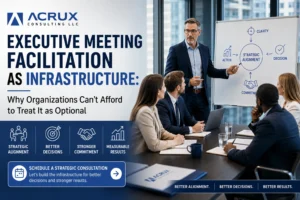
Executive Meeting Facilitation as Infrastructure: Why Organizations Can’t Afford to Treat It as Optional
When technology fails, leaders respond immediately. When financial controls break down, organizations act fast. But when meeting after meeting produces little clarity, weak alignment, and no accountable action, many teams simply schedule the next one.
That habit is more costly than it looks. Poor group process slows decisions, obscures real issues, and erodes follow-through. At Acrux Consulting, we provide executive meeting facilitation, strategic alignment consulting, and meeting facilitation services designed to help leadership teams move from discussion to decision with greater clarity and commitment.
What Infrastructure Actually Means
Infrastructure is the underlying system that makes everything else work. Roads don’t produce commerce but without them, commerce collapses. Power grids don’t generate innovation but without them, innovation stalls. The same logic applies to the processes by which people in organizations make decisions, set direction, and build shared commitment.
When those processes are absent or poorly designed, the consequences are predictable. The same voices dominate every conversation. Concerns surface too late, or not at all. Decisions reflect whoever spoke last rather than the best thinking in the room. Leaders leave sessions with different understandings of what was decided — and discover the divergence only after execution begins.
These are not personality problems. They are process failures. And process failures are infrastructure failures.
The Growing Need for Effective Meeting Facilitation
Several converging forces are making structured group process more important, not less.
First, the stakes of organizational decisions have risen. Volatility in markets, workforce expectations, and competitive landscapes means that alignment errors strategies that were never truly owned, decisions that were made without genuine commitment carry greater consequences than they did a decade ago. There is less margin for the slow drift that comes from weak group process.
Second, the workforce has changed. People are no longer willing to sit through meetings that fail them. They want transparency, genuine participation, and leaders who can create conditions for honest dialogue. Organizations that cannot provide this lose talent, trust, and momentum.
Third, artificial intelligence has entered the room. AI tools now handle many of the transactional elements of meetings transcription, summarization, action tracking with impressive efficiency. But this efficiency creates a dangerous illusion: that capturing what was said is the same as ensuring productive group work happened. It is not. The value of a well-facilitated session lies not in the transcript. It lies in the quality of thinking that occurred, the genuine alignment achieved, and the shared commitment generated. These outcomes require human expertise. They require a skilled facilitator.
What Certified Facilitators Provide
Skilled facilitation brings discipline to how groups think together. Whether the need is facilitating a strategy session, providing strategic team facilitation services, or serving as a professional meeting facilitator for a high-stakes executive discussion, the work is the same at its core: designing the right process, managing group dynamics constructively, and helping people move toward real decisions without forcing artificial agreement.
This last point is often underappreciated. In any significant group process, there is the conversation that happens in the room and the conversation that happens afterward. A skilled facilitator’s job is to close that gap to create conditions where the real issues emerge during the session, not in the hallway, not in a private message, not as passive resistance six weeks later.
No tool automates this. It requires judgment, presence, and professional discipline.
The Organizational Imperative
For leaders, investing in facilitation is not about making meetings feel smoother. It is about improving the quality of collective thinking, strengthening alignment, and increasing the odds that important decisions actually stick. That is why many organizations now seek facilitation services for executive teams, a meeting facilitator for leadership teams, or a business meeting facilitator who can guide difficult conversations with discipline and neutrality.
The real question is whether organizations will continue to treat facilitation as optional, or recognize it as part of the infrastructure required for strategy, execution, and organizational health.
At Acrux Consulting, we help executive teams, boards, and public-sector leaders design and facilitate the conversations that matter most from strategic planning facilitation services and strategic team facilitation services to decision-making forums where clarity and commitment are essential. As a strategic planning facilitator in New Jersey, Acrux also supports organizations that need meeting facilitation consulting, executive coaching for facilitation, and expert guidance in facilitating a strategy session that leads to action.

Diana Gurwicz
Acrux Consulting is a Linwood, New Jersey-based firm specializing in executive meeting facilitation, strategic planning facilitation services, strategic alignment consulting, and meeting facilitation services for leadership teams, boards, and public-sector organizations.